Tirzepatide Reconstitution Calculator
Tirzepatide vials come large and the titration runs long. Enter the vial, the water and this week's dose to see the exact mark on the syringe and how many injections the vial still holds.
Water doesn't change the dose — it changes how many units the dose takes up.
U-100 and U-50 share the same scale — 100 units per mL. The U-50 just has half the barrel (0.5 mL), so it stops at 50. The U-40 marks 40 units per mL, which is a different scale. Check what's printed on yours.
Fill in the vial, the water and the dose to see the result.
Personal journal. Not medical advice.
How the tirzepatide calculation works
The dose ladder runs from 2.5 to 15 mg, and every step is a different mark. The steps below are solved with a 10 mg vial in 2 mL.
Concentration
Milligrams in the vial ÷ mL of water = how many mg sit in each mL.
vial ÷ water = concentration10 mg ÷ 2 mL = 5 mg/mLVolume per dose
Dose ÷ concentration = how many mL you need to draw.
dose ÷ concentration = mL2.5 mg ÷ 5 = 0.5 mLUnits on the syringe
mL × 100 on a U-100 or U-50 syringe (or × 40 on a U-40) = the mark to stop at.
mL × 100 = units0.5 mL × 100 = 50 unitsThe whole thing in one formula
units = dose ÷ (vial ÷ water) × 100Vial in mg, water in mL, dose in mg. The 100 covers U-100 and U-50; swap it for 40 if your syringe is a U-40.
A 10 mg vial with 2 mL of water gives 5 mg/mL. A 2.5 mg dose takes up 0.5 mL — that's 50 units on a U-100 syringe.
The conversions people look up
How many units is 2.5 mg of tirzepatide?
50 units on a U-100, with a 10 mg vial reconstituted in 2 mL.
And 5 mg?
100 units — the full syringe. Above that you need less water or a bigger vial.
How do I lower the units without changing the dose?
Use less water. With 1 mL in a 10 mg vial (10 mg/mL), 2.5 mg drops to 25 units and 5 mg to 50.
What's the concentration of a 20 mg vial in 2 mL?
10 mg/mL. At that dilution, 5 mg is 0.5 mL — 50 units on a U-100.
Units by dose and dilution
A 10 mg vial on a U-100 syringe. Columns are the water you used to reconstitute.
| Dose | 1 mL | 2 mL | 3 mL | 5 mL |
|---|---|---|---|---|
| 2.5 mg | 25 | 50 | 75 | 125 |
| 5 mg | 50 | 100 | 150 | 250 |
| 7.5 mg | 75 | 150 | 225 | 375 |
| 10 mg | 100 | 200 | 300 | 500 |
| 15 mg | 150 | 300 | 450 | 750 |
Tirzepatide in practice
Tirzepatide works on two receptors at once — GIP and GLP-1 — which earned it the dual-agonist label. Like semaglutide it's weekly, and in compounded form it arrives lyophilized in a vial: the dilution is up to whoever reconstitutes it.
The dose ladder is long: it usually starts at 2.5 mg for four weeks and climbs in 2.5 mg steps — 5, 7.5, 10, 12.5 and 15 mg — always following response and clinical guidance. That's six possible steps, and each one is a different mark on the syringe.
That's why tirzepatide vials tend to be bigger, from 10 to 60 mg. A large vial is economical but demands more care: the more concentrated it is, the fewer units each dose occupies, and the less room for error between one step and the next when reading by eye.
Do this math once. Once.
In PepPro you enter the vial and the water a single time. From then on the app works out every injection on its own, shows the units on a visual syringe, reminds you at the right moment and keeps the whole history.
- Your reconstitution stays saved per vial
- Exact units on a visual syringe before you inject
- Reminders, titration and injection-site rotation
- Full history of doses, weight and how you feel
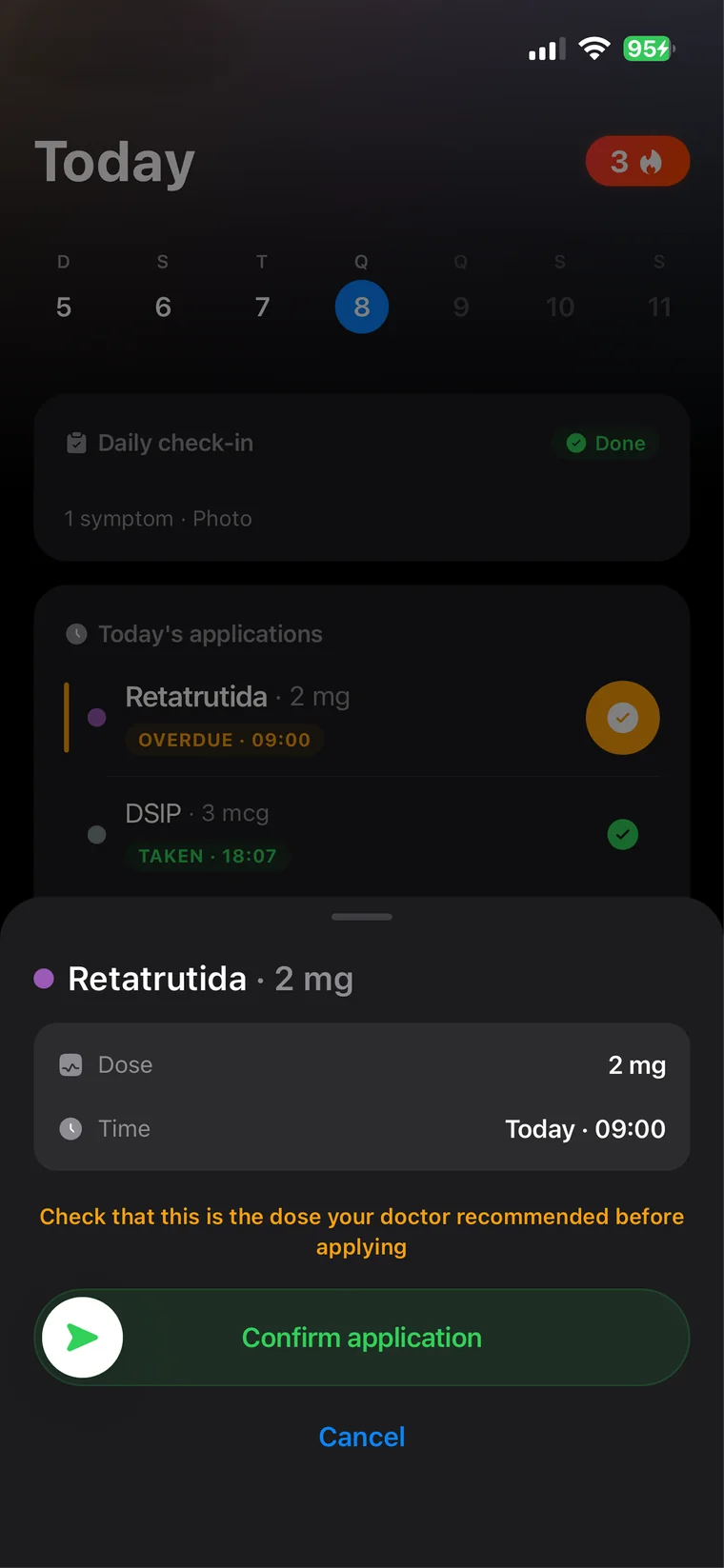
Exact units on a visual syringe before you inject
Good question. We've got answers.
Didn't find what you were after? Email us at contato@upsidecompany.com.br.
Let the vial reach room temperature, wipe the stopper with alcohol and inject the bacteriostatic water so it runs down the inner wall rather than jetting straight onto the powder. Swirl gently until fully dissolved — don't shake. Then store it refrigerated and away from light.
It depends on the size. A 10 mg vial gives four weeks at 2.5 mg, but disappears in two injections at 5 mg. The 30 and 60 mg vials exist precisely for the higher steps — and every new vial means redoing the math, since the dilution is rarely the same.
1 mL to 2 mL covers it well. With 1 mL, the 2.5 mg starting dose sits at 25 units and the higher doses still fit in a single injection. With 2 mL the reading is roomier (50 units), but 7.5 mg would already take 150 units — more than one syringe holds.
You don't need it. The manufactured pens and vials come pre-mixed with the dose already set, with no reconstitution. This calculator is for compounded tirzepatide, which arrives lyophilized and is diluted by you.
It depends which step you're on: eight injections at 2.5 mg, four at 5 mg, two at 10 mg. The calculator shows that number alongside the result, so you can order the next vial before the current one runs out mid-titration.
Yes — that's exactly what PepPro is for. Enter the vial and the reconstitution once and the app takes over: it works out every injection, shows the units on a visual syringe, reminds you when it's time and keeps the history of doses, weight and how you feel.
No. PepPro is a personal journal and this calculator is an educational tool. Nothing here replaces a qualified healthcare professional — they're the one who decides whether, how much and how you should use any compound.
Same math, presets ready
Pick the compound and the values come filled in.
Never miss a dose again
Try PepPro free and track your whole protocol — dose, schedule, weight and consistency — in one place.
Personal journal. Not medical advice.
Disclaimer
This calculator is for informational and educational purposes only and is not medical advice. Always confirm dosing with a qualified healthcare professional and double-check your own measurements before administering anything.