Semaglutide Half-Life Calculator
Semaglutide has a reported half-life of about one week — 165 hours. See how much of your last dose is left, when it's essentially gone and where a weekly protocol plateaus.
Fill in the vial, the water and the dose to see the result.
Personal journal. Not medical advice.
The curve of your protocol
Each step up is an injection; the light band is steady state, where what goes in matches what goes out.
How the semaglutide half-life calculation works
With a 165-hour half-life and injections every 168, the numbers come out almost round. The three calculations below are solved with those values.
Half every cycle
A half-life is how long your body takes to clear half of what's circulating. After two, a quarter is left; after three, an eighth.
remaining = dose × 0.5^(time ÷ half-life)0.5 mg × 0.5^(72 ÷ 165) = 0.369 mgFive is the magic number
After five half-lives about 3% is left — in practice, it's gone. It's the same number for reaching steady state when you keep injecting.
time to clear = 5 × half-life5 × 165 h = 825 h (34 days 9 h)That's why it stacks
Inject again before the last one clears and the leftover adds up. The build-up settles at a predictable plateau — that's what the curve shows.
accumulation = 1 ÷ (1 − 0.5^(interval ÷ half-life))1 ÷ (1 − 0.5^(168 ÷ 165)) = 1.98×The two calculations that matter
remaining = dose × 0.5^(t ÷ t½) · peak = dose × accumulationThe first answers “how much is still in me”; the second, “where does that settle if I keep injecting”. Keep time and half-life in the same unit.
A 0.5 mg dose with a 6 days 21 h half-life leaves 0.369 mg in your system after 3 days. Injecting every 7 days, the steady-state peak reaches 0.99 mg — 1.98× a single injection — and the compound is essentially gone in 34 days 9 h.
The conversions people look up
How much semaglutide is left after 7 days?
About 49% — essentially half, because the half-life (165 h) is almost exactly the weekly interval.
And after 3 days?
About 74%. The curve is shallow early on: the real drop only shows up after the first week.
And after 14 days?
About 24%, a quarter of the dose. Each week halves whatever was still there.
How long until half the dose is gone?
6 days and 21 hours — that's what a 165-hour half-life means.
Half by half
How much of one injection is left after each half-life.
| Half-lives | Time | Remaining |
|---|---|---|
| 1 | 6 days 21 h | 50% |
| 2 | 13 days 18 h | 25% |
| 3 | 20 days 15 h | 12.5% |
| 4 | 27 days 12 h | 6.25% |
| 5 | 34 days 9 h | 3.13% |
Why semaglutide is weekly
Semaglutide's reported half-life is roughly 165 hours, almost exactly seven days. That duration is what makes weekly injection possible: by the time the next dose arrives, about half the previous one is still circulating, so the curve never drops to the floor.
The direct consequence is accumulation. Injecting weekly, the steady-state peak sits at around twice the amount of a single dose, and the body takes about five half-lives — four to five weeks — to reach that plateau. It's the same reason titration steps usually run four weeks: before that, you haven't yet seen the full effect of your current dose.
It cuts both ways. On stopping, clearance also takes about five half-lives: over a month until only a negligible fraction is left. None of this is clinical guidance — it's just what half-life math says about the rhythm.
Do this math once. Once.
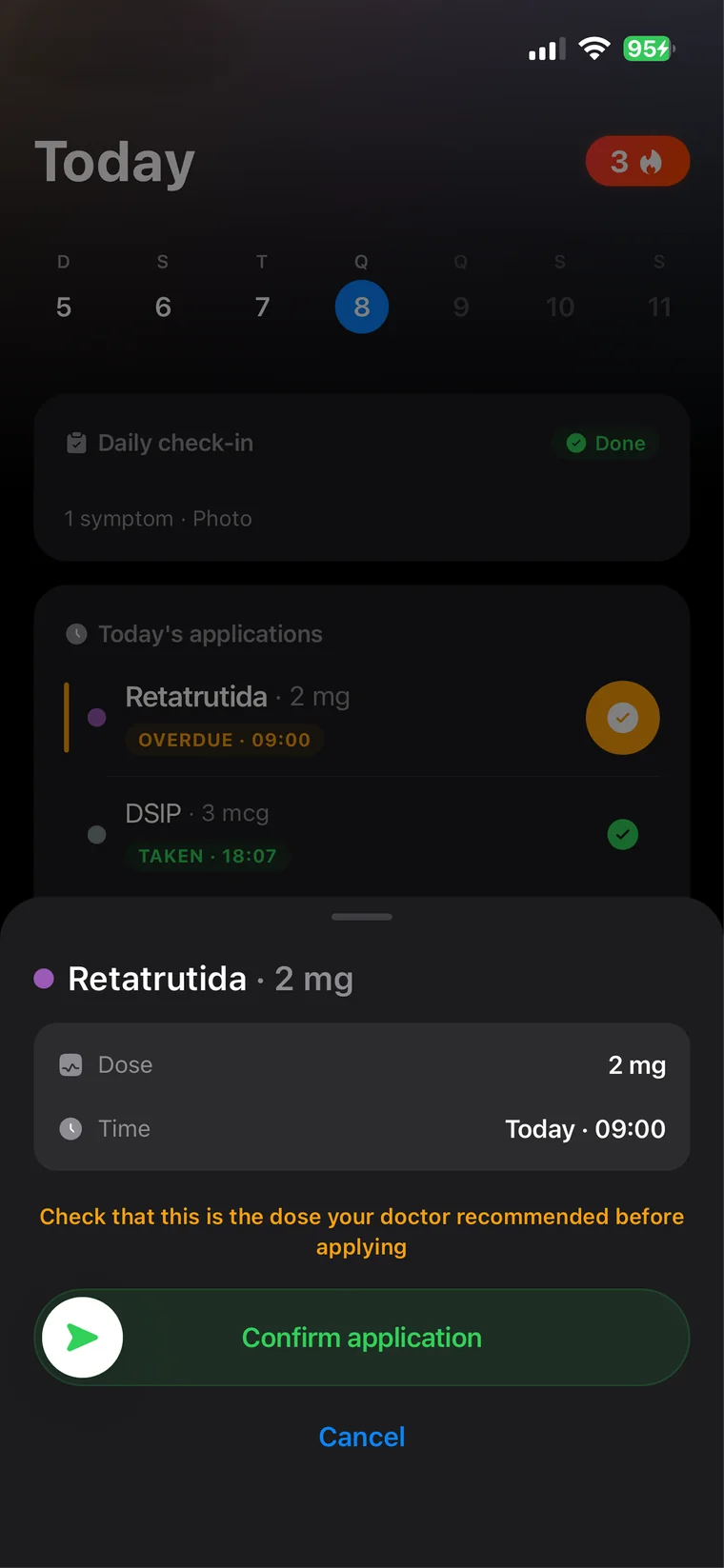
In PepPro you enter the vial and the water a single time. From then on the app works out every injection on its own, shows the units on a visual syringe, reminds you at the right moment and keeps the whole history.
- Your reconstitution stays saved per vial
- Exact units on a visual syringe before you inject
- Reminders, titration and injection-site rotation
- Full history of doses, weight and how you feel
Exact units on a visual syringe before you inject
Good question. We've got answers.
Didn't find what you were after? Email us at contato@upsidecompany.com.br.
About 165 hours, roughly one week. It's one of the longest half-lives among GLP-1 receptor agonists, and it's what makes weekly rather than daily injection workable.
By the five-half-lives ruler, about 34 days — a little over a month — until roughly 3% of a dose remains. Seven days after injecting, half is still there; after fourteen days, a quarter.
Also about five half-lives, so four to five weeks of weekly injections. Until then, every week carries a bit more in your system than the last, even at an unchanged dose.
The steady-state peak lands near twice that of a single injection, because the seven-day interval is almost equal to the half-life. You can check that number in the accumulation factor above by changing the interval.
The math says that one day past schedule, about 90% of what was there the day before is still present — the curve is shallow at that point. But what to do about a late dose is a clinical decision: follow your healthcare professional's guidance, not the calculator.
Yes — that's exactly what PepPro is for. Enter the vial and the reconstitution once and the app takes over: it works out every injection, shows the units on a visual syringe, reminds you when it's time and keeps the history of doses, weight and how you feel.
No. PepPro is a personal journal and this calculator is an educational tool. Nothing here replaces a qualified healthcare professional — they're the one who decides whether, how much and how you should use any compound.
Same math, presets ready
Pick the compound and the values come filled in.
Never miss a dose again
Try PepPro free and track your whole protocol — dose, schedule, weight and consistency — in one place.
Personal journal. Not medical advice.
Disclaimer
This calculator is for informational and educational purposes only and is not medical advice. Always confirm dosing with a qualified healthcare professional and double-check your own measurements before administering anything.