Peptide Half-Life Calculator
Enter the dose, the compound's half-life and the gap between injections. You get how much of a dose is left, when it's essentially gone and the plateau your protocol settles at.
Fill in the vial, the water and the dose to see the result.
Personal journal. Not medical advice.
The curve of your protocol
Each step up is an injection; the light band is steady state, where what goes in matches what goes out.
How the half-life calculation works
One constant of the compound and three calculations on top of it: how much is left, how long until it clears and where the protocol settles. Each is solved below with the calculator's values.
Half every cycle
A half-life is how long your body takes to clear half of what's circulating. After two, a quarter is left; after three, an eighth.
remaining = dose × 0.5^(time ÷ half-life)1 mg × 0.5^(72 ÷ 165) = 0.739 mgFive is the magic number
After five half-lives about 3% is left — in practice, it's gone. It's the same number for reaching steady state when you keep injecting.
time to clear = 5 × half-life5 × 165 h = 825 h (34 days 9 h)That's why it stacks
Inject again before the last one clears and the leftover adds up. The build-up settles at a predictable plateau — that's what the curve shows.
accumulation = 1 ÷ (1 − 0.5^(interval ÷ half-life))1 ÷ (1 − 0.5^(168 ÷ 165)) = 1.98×The two calculations that matter
remaining = dose × 0.5^(t ÷ t½) · peak = dose × accumulationThe first answers “how much is still in me”; the second, “where does that settle if I keep injecting”. Keep time and half-life in the same unit.
A 1 mg dose with a 6 days 21 h half-life leaves 0.739 mg in your system after 3 days. Injecting every 7 days, the steady-state peak reaches 1.98 mg — 1.98× a single injection — and the compound is essentially gone in 34 days 9 h.
The conversions people look up
What's the half-life formula?
remaining = dose × 0.5^(time ÷ half-life). Time and half-life have to be in the same unit.
How much is left after 3 half-lives?
12.5%. After 4, 6.25%; after 5, about 3% — the point where it's treated as cleared.
How do I calculate accumulation with repeat dosing?
accumulation = 1 ÷ (1 − 0.5^(interval ÷ half-life)). Multiply by the dose to get the steady-state peak.
How long until steady state?
Five half-lives, the same number as clearance — and it doesn't change with the dose.
Half by half
How much of one injection is left after each half-life.
| Half-lives | Time | Remaining |
|---|---|---|
| 1 | 6 days 21 h | 50% |
| 2 | 13 days 18 h | 25% |
| 3 | 20 days 15 h | 12.5% |
| 4 | 27 days 12 h | 6.25% |
| 5 | 34 days 9 h | 3.13% |
What a half-life explains — and what it doesn't
A half-life is how long your body takes to clear half of what's circulating. It's a property of the compound, not the dose: 10 mg and 1 mg both halve over the same interval. That makes it the best ruler for rhythm — how often reinjecting makes sense, and how long until it's fully gone.
Two practical questions come out of that. How long until it disappears: after five half-lives about 3% is left, which in practice counts as cleared. And what happens if you reinject before then: the leftover adds to the new dose, and the total climbs until it settles at a plateau — steady state, which the curve below draws as a band.
What a half-life doesn't explain: absorption speed, person-to-person variation and clinical effect. A subcutaneous injection takes hours to peak, and this model only describes the way down. Treat the numbers as orders of magnitude, not as lab results.
Do this math once. Once.
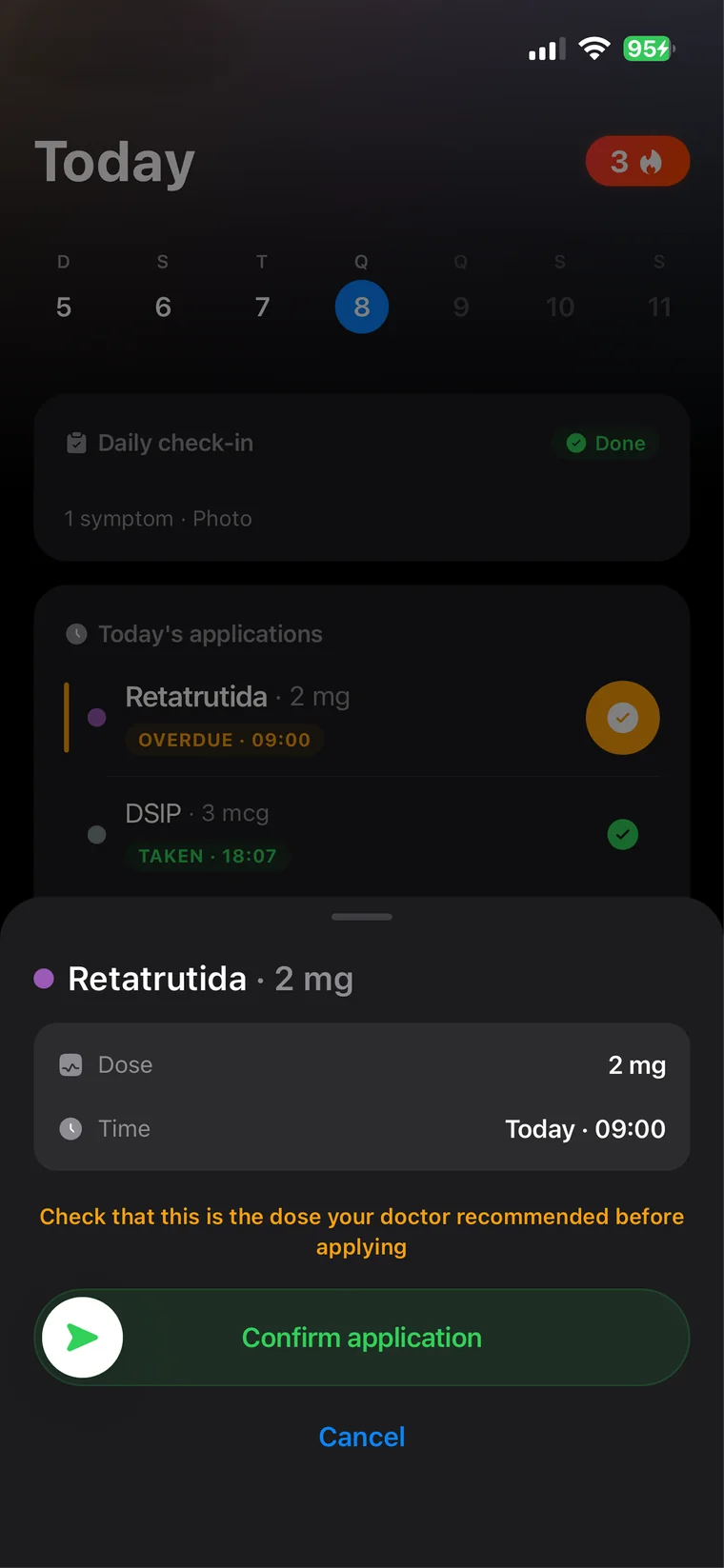
In PepPro you enter the vial and the water a single time. From then on the app works out every injection on its own, shows the units on a visual syringe, reminds you at the right moment and keeps the whole history.
- Your reconstitution stays saved per vial
- Exact units on a visual syringe before you inject
- Reminders, titration and injection-site rotation
- Full history of doses, weight and how you feel
Exact units on a visual syringe before you inject
Good question. We've got answers.
Didn't find what you were after? Email us at contato@upsidecompany.com.br.
It's the time your body needs to clear half of the amount circulating. After one half-life 50% is left, after two 25%, after three 12.5%, and so on. The percentage always halves, so the drop is fast at first and slower every cycle.
The usual ruler is five half-lives: about 3% is left, which is generally treated as cleared. For a 24-hour compound that's five days; for a seven-day one, more than a month. Technically it never reaches zero, but past that point the amount stops mattering in practice.
Because the new injection arrives before the previous one is fully gone. What's left adds to what came in, and the total climbs each cycle — but not without limit: the larger the accumulated amount, the more your body clears per hour, until output matches input.
It's the point where what goes in with each injection exactly matches what your body clears over that interval. From then on the curve repeats the same shape every week, between a constant peak and a constant trough. Getting there takes about five half-lives — the same number as clearance.
No. Half-life describes the amount in your system; the effect depends on receptors, sensitivity and how much is needed to produce a response. A compound can still be present with no noticeable effect, and the reverse happens too. They're different rulers.
Yes — that's exactly what PepPro is for. Enter the vial and the reconstitution once and the app takes over: it works out every injection, shows the units on a visual syringe, reminds you when it's time and keeps the history of doses, weight and how you feel.
No. PepPro is a personal journal and this calculator is an educational tool. Nothing here replaces a qualified healthcare professional — they're the one who decides whether, how much and how you should use any compound.
Same math, presets ready
Pick the compound and the values come filled in.
Never miss a dose again
Try PepPro free and track your whole protocol — dose, schedule, weight and consistency — in one place.
Personal journal. Not medical advice.
Disclaimer
This calculator is for informational and educational purposes only and is not medical advice. Always confirm dosing with a qualified healthcare professional and double-check your own measurements before administering anything.