BPC-157 Dose Calculator
BPC-157 is dosed in micrograms, but the syringe is marked in units. Enter the vial and the water you reconstituted with to get the right mark — and how many injections the vial still holds.
Water doesn't change the dose — it changes how many units the dose takes up.
U-100 and U-50 share the same scale — 100 units per mL. The U-50 just has half the barrel (0.5 mL), so it stops at 50. The U-40 marks 40 units per mL, which is a different scale. Check what's printed on yours.
Fill in the vial, the water and the dose to see the result.
Personal journal. Not medical advice.
How the BPC-157 calculation works
The difference here is the unit: doses come in micrograms and have to become milligrams before they enter the formula. The steps below use a 5 mg vial in 2 mL.
Concentration
Milligrams in the vial ÷ mL of water = how many mg sit in each mL.
vial ÷ water = concentration5 mg ÷ 2 mL = 2.5 mg/mLVolume per dose
Dose ÷ concentration = how many mL you need to draw.
dose ÷ concentration = mL0.25 mg ÷ 2.5 = 0.1 mLUnits on the syringe
mL × 100 on a U-100 or U-50 syringe (or × 40 on a U-40) = the mark to stop at.
mL × 100 = units0.1 mL × 100 = 10 unitsThe whole thing in one formula
units = dose ÷ (vial ÷ water) × 100Vial in mg, water in mL, dose in mg. The 100 covers U-100 and U-50; swap it for 40 if your syringe is a U-40.
A 5 mg vial with 2 mL of water gives 2.5 mg/mL. A 250 mcg dose takes up 0.1 mL — that's 10 units on a U-100 syringe.
The conversions people look up
How many units is 250 mcg of BPC-157?
10 units on a U-100, with a 5 mg vial reconstituted in 2 mL.
And 500 mcg?
20 units in the same vial. 750 mcg gives 30 and 1000 mcg gives 40.
What's the concentration of a 5 mg vial in 2 mL?
2.5 mg/mL. With 1 mL of water it would be 5 mg/mL, and 250 mcg would land on 5 units instead of 10.
What about a 10 mg vial?
The concentration doubles to 5 mg/mL with 2 mL of water: 250 mcg then takes up just 5 units.
Units by dose and dilution
A 5 mg vial on a U-100 syringe. Columns are the water you used to reconstitute.
| Dose | 1 mL | 2 mL | 3 mL | 5 mL |
|---|---|---|---|---|
| 250 mcg | 5 | 10 | 15 | 25 |
| 500 mcg | 10 | 20 | 30 | 50 |
| 750 mcg | 15 | 30 | 45 | 75 |
| 1,000 mcg | 20 | 40 | 60 | 100 |
Why BPC-157 trips people up
BPC-157 is a fifteen-amino-acid peptide derived from a protein found in gastric juice. It's a research compound: it has no approval as a medicine, and most of what's known about it comes from animal studies. Nothing here suggests you should use it — this page exists so people who already do don't get the math wrong.
Its particular trap is the unit. While GLP-1s are dosed in milligrams, BPC-157 is almost always written in micrograms: 250, 500, 750 mcg. Since 1 mg equals 1000 mcg, slipping between the two scales is a thousand-fold error — not a ten-percent one.
Add to that how small the doses are relative to the vial. A 5 mg vial holds twenty 250 mcg injections, which means tiny volumes: with little water, a dose can land on two or three units, hard to hit accurately. Diluting further is what brings the reading back into a safe range.
Do this math once. Once.
In PepPro you enter the vial and the water a single time. From then on the app works out every injection on its own, shows the units on a visual syringe, reminds you at the right moment and keeps the whole history.
- Your reconstitution stays saved per vial
- Exact units on a visual syringe before you inject
- Reminders, titration and injection-site rotation
- Full history of doses, weight and how you feel
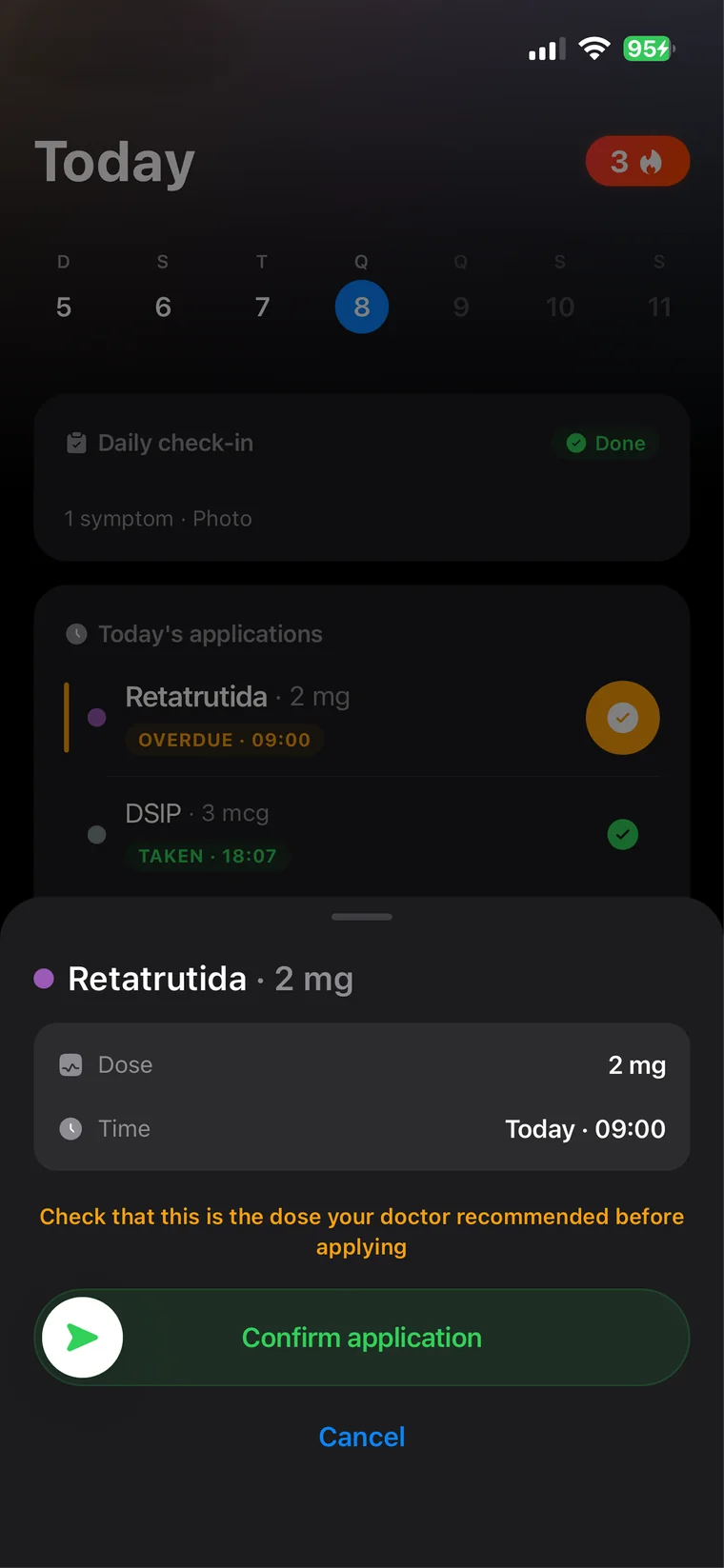
Exact units on a visual syringe before you inject
Good question. We've got answers.
Didn't find what you were after? Email us at contato@upsidecompany.com.br.
Once reconstituted, always: refrigerated and away from light. The lyophilized powder tolerates room temperature for longer, but refrigerating it is still the standard. Avoid freezing — freeze-thaw cycles degrade the peptide.
1 mg = 1000 mcg. The milligram is the unit on the vial label; the microgram is the unit BPC-157 doses are usually written in. Confusing the two is the most expensive mistake in this calculation, because the gap is a factor of a thousand.
2 mL to 3 mL usually gives the most comfortable reading for 250 to 500 mcg doses. With 2 mL, 250 mcg sits at 10 units and 500 mcg at 20 — easy numbers to double-check. With only 1 mL, that same 250 mcg would land on 5 units, doubling your margin of reading error.
Twenty injections at 250 mcg, ten at 500 mcg, or five at 1000 mcg. If your protocol is twice daily, a 5 mg vial at 250 mcg covers ten days — and the app warns you when it's about to run out.
Yes. In PepPro each compound has its own vial, frequency and history, but they all show up on the same schedule and the same timeline. Running a daily peptide and a weekly one side by side without mixing up the doses is a common setup.
Yes — that's exactly what PepPro is for. Enter the vial and the reconstitution once and the app takes over: it works out every injection, shows the units on a visual syringe, reminds you when it's time and keeps the history of doses, weight and how you feel.
No. PepPro is a personal journal and this calculator is an educational tool. Nothing here replaces a qualified healthcare professional — they're the one who decides whether, how much and how you should use any compound.
Same math, presets ready
Pick the compound and the values come filled in.
Never miss a dose again
Try PepPro free and track your whole protocol — dose, schedule, weight and consistency — in one place.
Personal journal. Not medical advice.
Disclaimer
This calculator is for informational and educational purposes only and is not medical advice. Always confirm dosing with a qualified healthcare professional and double-check your own measurements before administering anything.